Florida septic permit requirements by county: who issues the permit?#
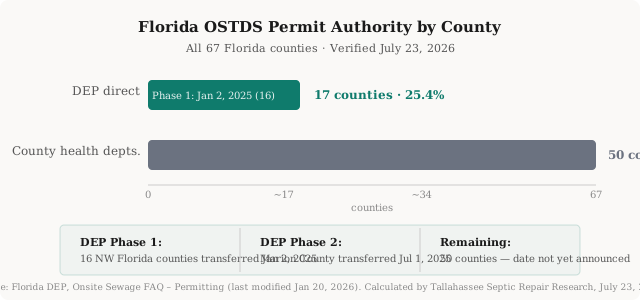
Florida’s septic program was administered by the Department of Health under Chapter 64E-6 until the Clean Waterways Act (Chapter 2020-150) transferred it to DEP effective July 1, 2021. County health departments continue to administer permits and inspections in 50 counties under the statewide DEP program during a phased transition. DEP has issued permits directly in 17 counties since 2025.
The 17 counties where DEP issues the permit
For a parcel in any of these counties, the OSTDS construction-permit application goes to DEP through the state portal or accepted paper route using the current DEP Form 4015 packet.
| County | Permitting authority | Transfer effective | Verification |
|---|---|---|---|
| Bay | Florida DEP | January 2, 2025 | ★ |
| Calhoun | Florida DEP | January 2, 2025 | ★ |
| Escambia | Florida DEP | January 2, 2025 | ★ |
| Franklin | Florida DEP | January 2, 2025 | ★ |
| Gadsden | Florida DEP | January 2, 2025 | ★ |
| Gulf | Florida DEP | January 2, 2025 | ★ |
| Holmes | Florida DEP | January 2, 2025 | ★ |
| Jackson | Florida DEP | January 2, 2025 | ★ |
| Jefferson | Florida DEP | January 2, 2025 | ★ |
| Leon | Florida DEP | January 2, 2025 | ★ |
| Liberty | Florida DEP | January 2, 2025 | ★ |
| Marion | Florida DEP | July 1, 2025 | ★ |
| Okaloosa | Florida DEP | January 2, 2025 | ★ |
| Santa Rosa | Florida DEP | January 2, 2025 | ★ |
| Wakulla | Florida DEP | January 2, 2025 | ★ |
| Walton | Florida DEP | January 2, 2025 | ★ |
| Washington | Florida DEP | January 2, 2025 | ★ |
Sources: Florida DEP permitting page and transition table. Retrieved and verified July 23, 2026. floridadep.gov/water/onsite-sewage/content/onsite-sewage-faq-permitting
The 50 counties where a county health department issues the permit
For a parcel in any of these counties, the OSTDS application goes to the Florida Department of Health county health department. Confirm the current local intake method before filing — processes differ by county. The current statewide form packet is DEP Form 4015 (June 2026).
* Gilchrist and Lafayette are reconciled from DEP’s statewide count and confirmed via official county DOH pages. See Which two counties are missing from the state table?
| County | Permitting authority | Verification |
|---|---|---|
| Alachua | Florida Department of Health in Alachua County | ★ |
| Baker | Florida Department of Health in Baker County | ★ |
| Bradford | Florida Department of Health in Bradford County | ★ |
| Brevard | Florida Department of Health in Brevard County | ★ |
| Broward | Florida Department of Health in Broward County | ★ |
| Charlotte | Florida Department of Health in Charlotte County | ★ |
| Citrus | Florida Department of Health in Citrus County | ★ |
| Clay | Florida Department of Health in Clay County | ★ |
| Collier | Florida Department of Health in Collier County | ★ |
| Columbia | Florida Department of Health in Columbia County | ★ |
| DeSoto | Florida Department of Health in DeSoto County | ★ |
| Dixie | Florida Department of Health in Dixie County | ★ |
| Duval | Florida Department of Health in Duval County | ★ |
| Flagler | Florida Department of Health in Flagler County | ★ |
| Gilchrist ◆ | Florida Department of Health in Gilchrist County | ★ |
| Glades | Florida Department of Health in Glades County | ★ |
| Hamilton | Florida Department of Health in Hamilton County | ★ |
| Hardee | Florida Department of Health in Hardee County | ★ |
| Hendry | Florida Department of Health in Hendry County | ★ |
| Hernando | Florida Department of Health in Hernando County | ★ |
| Highlands | Florida Department of Health in Highlands County | ★ |
| Hillsborough | Florida Department of Health in Hillsborough County | ★ |
| Indian River | Florida Department of Health in Indian River County | ★ |
| Lafayette ◆ | Florida Department of Health in Lafayette County | ★ |
| Lake | Florida Department of Health in Lake County | ★ |
| Lee | Florida Department of Health in Lee County | ★ |
| Levy | Florida Department of Health in Levy County | ★ |
| Madison | Florida Department of Health in Madison County | ★ |
| Manatee | Florida Department of Health in Manatee County | ★ |
| Martin | Florida Department of Health in Martin County | ★ |
| Miami-Dade | Florida Department of Health in Miami-Dade County | ★ |
| Monroe | Florida Department of Health in Monroe County | ★ |
| Nassau | Florida Department of Health in Nassau County | ★ |
| Okeechobee | Florida Department of Health in Okeechobee County | ★ |
| Orange | Florida Department of Health in Orange County | ★ |
| Osceola | Florida Department of Health in Osceola County | ★ |
| Palm Beach | Florida Department of Health in Palm Beach County | ★ |
| Pasco | Florida Department of Health in Pasco County | ★ |
| Pinellas | Florida Department of Health in Pinellas County | ★ |
| Polk | Florida Department of Health in Polk County | ★ |
| Putnam | Florida Department of Health in Putnam County | ★ |
| Sarasota | Florida Department of Health in Sarasota County | ★ |
| Seminole | Florida Department of Health in Seminole County | ★ |
| St. Johns | Florida Department of Health in St. Johns County | ★ |
| St. Lucie | Florida Department of Health in St. Lucie County | ★ |
| Sumter | Florida Department of Health in Sumter County | ★ |
| Suwannee | Florida Department of Health in Suwannee County | ★ |
| Taylor | Florida Department of Health in Taylor County | ★ |
| Union | Florida Department of Health in Union County | ★ |
| Volusia | Florida Department of Health in Volusia County | ★ |
Sources: Florida DEP permitting page; Florida Department of Health county directory; official Gilchrist and Lafayette county pages. Retrieved and verified July 23, 2026. floridadep.gov – Onsite Sewage FAQ · floridahealth.gov – County Health Departments
Which two counties are missing from Florida’s permitting table?#
DEP’s permitting page says 50 counties remain with county health departments, but its displayed table names 48. Gilchrist and Lafayette appear in neither displayed column. Both are included here as county-health-department counties because the statewide arithmetic requires 50 and current official county pages independently confirm the relevant environmental-health and onsite-sewage functions.
Here is the reconciliation:
- Florida has 67 counties.
- DEP’s displayed DEP column names 17 counties.
- 67 − 17 = 50, matching DEP’s statement that the remaining 50 counties will transfer later.
- DEP’s displayed county-health-department column names 48 counties.
- 50 − 48 = 2 unaccounted-for counties.
- The two counties absent from both displayed columns are Gilchrist and Lafayette.
- Gilchrist’s official Environmental Public Health page states that its Environmental Health Section provides permitting services.
- Lafayette’s official county page maintains onsite-sewage applications, permits, repair records, site evaluations and inspections.
This is a gap in a displayed list, not a claim that DEP’s count of 50 is wrong. The count is internally consistent; the visible list is short by two. A reader who copies the list without checking the statewide count will omit two counties.
Where does the statewide transition stand now?#
Current official publications are not synchronized on a projected completion date. DEP’s operational permitting page says the remaining transfers are to be determined depending on legislative approval, while January 28 and May 7, 2026 House analyses still repeat an earlier July 2025-through-December 2026 range. This dataset uses the current county assignments and does not publish an unconfirmed completion date.
DEP’s Onsite Sewage FAQ – Permitting page (last modified January 20, 2026) gives this timeline:
- Phase 1, Escambia County through Jefferson County: January 2, 2025.
- Marion County: July 1, 2025.
- Remaining counties: to be determined depending on legislative approval.
A Florida House staff analysis dated January 28, 2026 and the final bill analysis dated May 7, 2026 state that the balance would transfer between July 2025 and December 2026, citing DEP material. Because DEP’s current operating page does not provide that completion date, version 1.0 reports the actual current route for each county rather than projecting the remaining transition.
How was this dataset built?#
This reference was built by reading primary sources directly on July 23, 2026 and normalizing them into one county-level dataset. No statistic, fee or legal requirement on this page was sourced from a contractor blog, a cost-estimate site or another private compilation.
What we collected, and from where.The source set includes DEP’s permitting page and transition table; DEP’s current forms and program pages; current ENR and springs pages; the Florida Department of Health county directory; official Gilchrist, Lafayette, Leon, Lee and Charlotte pages; sections 381.0065, 381.0066 and 403.182, Florida Statutes; Chapters 2020-150, 2023-169, 2026-2 and 2026-62, Laws of Florida; the complete Chapter 62-6 rule index; the current Rule 62-6.004, 62-6.005, 62-6.011 and 62-6.030 records; the April 9, 2026 proposed-rule publication and May 12 technical correction in the Florida Administrative Register; and the official House analyses for CS/CS/CS/HB 589.
How we processed it. Each source was reduced to discrete fields: county, permitting authority, authority type, transfer date, application route, current state form packet, fee evidence, fee verification status, nutrient-reduction overlay note, routing verification, verification date and primary source URL. Where a state count disagreed with a displayed list, the arithmetic was documented and the missing counties were checked against independent official county sources. Where an agency summary disagreed with enacted law, the enacted law controls and the dated conflict remains visible. A missing fee was never converted to zero, and a modeled or typical amount was never substituted for an official fee.
What is original here.The statutes, rules, forms and county schedules are government records. The original work is the join: the 67-county authority assignment; the documented Gilchrist/Lafayette reconciliation; the field-level verification model; the Chapter 62-6 currency map; the side-by-side of Chapter 2026-2 against DEP’s current summary; the current-form conflict between the incorporated June 2026 form and a county page still distributing the 2022 edition; and the timestamped CSV and JSON distributions.
Reproducing the county counts:
DEP-administered counties          = 17
County health department counties  = 50
Total Florida counties             = 67
DEP share                           = 17 ÷ 67 = 25.4%
County health department share     = 50 ÷ 67 = 74.6%
Counties named in DEP's CHD list    = 48
Counties reconciled                 = 50 − 48 = 2 (Gilchrist, Lafayette)
What does Florida require for a septic permit in every county?#
The permit requirement itself is statewide: under s. 381.0065(4), Florida Statutes, as amended in 2026, a person may not construct, repair, modify, abandon or operate an OSTDS without an approved permit. Florida law and Chapter 62-6 also establish baseline standards, but special statutory regimes, legacy-lot provisions, variances, stricter approved local requirements and site-specific conditions can change how a baseline applies to a particular property.
| Requirement | Current value or rule | Primary source | Ver. |
|---|---|---|---|
| Permit required | Yes, statewide — to construct, repair, modify, abandon or operate | s. 381.0065(4), F.S., as amended by ch. 2026-62 | ★ |
| Construction permit validity | 18 months; one 90-day extension may be granted | s. 381.0065(4), F.S., as amended by ch. 2026-62 | ★ |
| Repair permit validity | 90 days | s. 381.0065(4), F.S., as amended by ch. 2026-62 | ★ |
| Commercial-waste operating permit | 1 year, renewed annually | s. 381.0065(4), F.S., as amended by ch. 2026-62 | ★ |
| Aerobic treatment unit operating permit | 2 years, renewed every 2 years | s. 381.0065(4), F.S., as amended by ch. 2026-62 | ★ |
| Private or limited-use water-supply subdivision route | At least 1/2 acre and either a 100-foot minimum dimension or the statutory 100-foot mean-dimension test, subject to remaining conditions and exceptions | s. 381.0065(4)(c), F.S., as amended by ch. 2026-62 | ★ |
| Maximum projected flow under that route | Average no more than 1,500 gallons per acre per day | s. 381.0065(4)(c), F.S., as amended by ch. 2026-62 | ★ |
| Setback from a private potable well | 75 feet under the general current rule | R. 62-6.005(1)(a), F.A.C. | ★ |
| Setback from a public well serving 2,000 gpd or less | 100 feet under the general current rule | R. 62-6.005(1)(b), F.A.C. | ★ |
| Setback from a public well serving more than 2,000 gpd | 200 feet under the general current rule | R. 62-6.005(1)(c), F.A.C. | ★ |
| Setback from a nonpotable well | 50 feet under the general current rule | R. 62-6.005(1)(d), F.A.C. | ★ |
| Setback from a storm-sewer pipe | 10 feet to the maximum extent possible; never less than 5 feet | R. 62-6.005(1)(e), F.A.C. | ★ |
| Setback from a building foundation, property line or pool wall | 5 feet under the general current rule | R. 62-6.005(2), F.A.C. | ★ |
| Lateral setback from a surface-water body | 75 feet under the general current rule; statutory and rule exceptions exist | R. 62-6.005(3), F.A.C.; s. 381.0065(4), F.S. | ★ |
| Unobstructed area | At least 1.5 times the required drainfield absorption area | R. 62-6.005(4)(a), F.A.C. | ★ |
| Site-evaluation timing | No earlier than 180 days before DEP receives the application; valid for the life of the construction permit | R. 62-6.004(3), F.A.C., effective June 8, 2026 | ★ |
| Agency review clock | Initial additional-information request within 30 days; applicant generally has 90 days to respond, with one timely extension of up to 90 days; final action within 90 days after completion | R. 62-6.004(5), F.A.C. | ★ |
| Point-of-sale inspection | May not be mandated by a governmental entity, subject to the consolidated-government carve-out | s. 381.0065(4)(x), F.S., as amended by ch. 2026-62 | ★ |
| Single-family remodel with no added bedroom | No existing-system inspection, evaluation, modification, replacement or upgrade is required; work may not cover the system or encroach on a setback or unobstructed area; plan verification governed by a 7-business-day clock | s. 381.0065(4)(bb), F.S., as amended by ch. 2026-62 | ★ |
| Land application of septage | Prohibited since January 1, 2016 | s. 381.0065(6), F.S. | ★ |
| Bedroom definition (site-built) | At least 70 sq. ft. of conditioned space; along an exterior wall; closet; door or operable entrance; the statutory definition also requires an emergency escape-and-rescue opening | s. 381.0065(2)(b), F.S. | ★ |
Sources: s. 381.0065, Florida Statutes (2025), read together with Chapter 2026-62, Laws of Florida; Rules 62-6.004 and 62-6.005, Florida Administrative Code, effective June 8, 2026. Verified July 23, 2026. s. 381.0065, F.S. · Ch. 2026-62 · R. 62-6.004 · R. 62-6.005
Which rules in Florida’s septic rulebook are current?
Chapter 62-6 is not one document with one date. Ten of its 33 rules took effect June 8, 2026. Two rules still carry March 22, 2000 as their latest effective date, which means publication date alone cannot tell a reader whether a guide is using the current version of every rule it discusses.
| Current effective date | Rules |
|---|---|
| June 8, 2026 | 62-6.004 Application for System Construction Permit · 62-6.005 Location and Installation · 62-6.011 Abandonment of Systems · 62-6.013 Construction Materials and Standards for Tanks · 62-6.019 Requirements for Registration · 62-6.020 Registration to Become a Master Septic Tank Contractor · 62-6.021 Issuance and Renewal of Annual Registration · 62-6.022 Disciplinary Standards · 62-6.023 Certification of Septic Tank Contracting, Partnerships, and Corporations · 62-6.030 Fees |
| July 9, 2025 | 62-6.001 General · 62-6.002 Definitions · 62-6.003 Permits and Inspections · 62-6.024 Private Provider Inspectors · 62-6.027 Permits and Inspections |
| June 21, 2022 | 62-6.009 Alternative Systems · 62-6.010 Septage and Food Establishment Sludge · 62-6.0101 Portable Restrooms and Portable or Stationary Holding Tanks · 62-6.012 Standards for Construction, Operation, and Maintenance of Aerobic Treatment Units · 62-6.014 Construction Standards for Drainfield Systems · 62-6.025 Definitions |
| July 16, 2013 | 62-6.008 System Size Determinations · 62-6.0181 System Repair and Cesspit and Undocumented System Replacement · 62-6.028 Location and Installation |
| April 28, 2010 | 62-6.015 Permitting and Construction of Repairs · 62-6.026 Applications for Innovative System Permits |
| June 25, 2009 | 62-6.0151 Product Composition |
| November 26, 2006 | 62-6.006 Site Evaluation Criteria · 62-6.018 System Location, Design and Maintenance Criteria |
| June 18, 2003 | 62-6.029 Monitoring · 62-6.0295 Innovative System Reclassification |
| March 22, 2000 | 62-6.017 Definitions · 62-6.0182 Coordinated Permitting |
Source: Florida Administrative Code, Chapter 62-6 rule index, showing the latest adopted effective date for each rule. Retrieved and verified July 23, 2026. flrules.org/gateway/ChapterHome.asp?Chapter=62-6
Is the application form the same in every county?
The current statewide form is DEP Form 4015, Application for Onsite Sewage Treatment and Disposal System Construction Permit, June 2026. DEP’s forms page lists that edition, Rule 62-6.004 incorporates it, and the form itself states that it obsoletes prior editions and that prior editions may not be used.
On July 23, 2026, DOH-Lee linked to DEP-4015-June-2026.pdf, while DOH-Charlotte’s repair page linked to DEP4015-2022Update-fillableFINAL.pdf. That is a current primary-source conflict: one official county page distributes the current edition and another still distributes the June 21, 2022 edition. Use the current June 2026 form on DEP’s forms page. Where a county page still links an older edition, confirm the current filing packet with the administering office before submission.
The current base packet consists of the application, a site plan, the building floor plan, the site evaluation and system specifications, and — where applicable — the existing-system and repair evaluation.
What does a Florida septic permit cost, and why does it change by county?#
Florida law does not create one statewide total septic-permit price. Section 381.0066(2) establishes 12 fee categories or charges with statutory floors and/or ceilings, DEP sets fee amounts by rule within those limits, and county health departments determine the total permitting fee — including county fees — in the counties they administer. A Lee County new-system amount and a Charlotte County repair amount can both be current without being comparable statewide averages.
What are the statutory fee bands?
| Fee category | Statutory floor | Statutory ceiling |
|---|---|---|
| Application review, permit issuance, or system inspection — including specified repair and abandoned-system permitting services — whether performed by the department or a private-provider inspector | $25 | $125 |
| Site evaluation, site reevaluation, evaluation of a system previously in use, or annual septage-disposal-site evaluation | $40 | $115 |
| Biennial operating permit for an aerobic treatment unit or performance-based treatment system | — | $100 |
| Annual operating permit for industrial or manufacturing-zoned areas or nondomestic wastewater | $150 | $300 |
| Innovative technology | — | $25,000 |
| Annual septage-disposal service, septage-stabilization facility, portable or temporary toilet service, or tank-manufacturer inspection | $25 | $200 |
| Application for variance | $150 | $300 |
| Annual operating permit for waterless, incinerating or organic-waste composting toilets | $15 | $30 |
| Annual aerobic-treatment-unit or performance-based-system maintenance-entity permit | $25 | $150 |
| Reinspection per visit after construction approval or for a noncompliant installation | $25 | $100 |
| Research surcharge added to each new-system construction permit | $5 fixed | $5 fixed |
| Annual operating permit for an engineer-designed performance-based system, including annual inspection and required sampling and laboratory analysis | $150 | $300 |
Source: s. 381.0066(2), Florida Statutes (2025). Read and verified July 23, 2026. s. 381.0066, F.S.
Five dollars from each repair-permit fee collected is directed to the hands-on training centers described in s. 381.0065(3)(j). Once DEP begins implementing the program within a county, the statutory notes also redirect collected program fees to the Florida Permit Fee Trust Fund and end DOH implementation and fee collection in that county unless a separate delegation or contract provides otherwise.
Which county fees were verified?
Version 1.0 publishes county dollar amounts only where the amount was read on a current official county page. Two counties met that standard in this release.
| County | Permit type | Amount | Additional charges or qualifications | Source checked |
|---|---|---|---|---|
| Lee | New-system application | $390 | $155 if a site evaluation is determined to be needed; $100 for inspections on outer islands accessible only by boat; $465 application fee for a performance-based treatment system | July 23, 2026 |
| Charlotte | Repair or replacement application | $475 | The official page says the amount may be lower if the existing system is less than five years old | July 23, 2026 |
Sources: Florida Department of Health in Lee County, “New Septic System Application Requirements” lee.floridahealth.gov – OSTDS New Permit · Florida Department of Health in Charlotte County, “Repair or Replace Septic Permit” charlotte.floridahealth.gov – Repair or Replacement Permit · both retrieved and verified July 23, 2026.
Which Florida counties require more than the state minimum?#
Florida law preserves several mechanisms for requirements above the statewide baseline. DEP says many counties have local ordinances that may exceed state OSTDS requirements, while the statutes preserve local public-health authority, approved local pollution-control programs, a limited pre-2012 performance-based-system exception and special statutory regimes.
| Mechanism | What it permits or preserves | Primary source | Ver. |
|---|---|---|---|
| General reservation of local public-health power | The septic statute does not limit municipal or county enforcement of other laws protecting public health and safety | s. 381.0065(4)(s), F.S., as amended by ch. 2026-62 | ★ |
| Local pollution-control program | A county or municipality may adopt requirements compatible with, stricter than or more extensive than state law, subject to DEP approval and enforcement provisions | s. 403.182(1)(b), (6), F.S. | ★ |
| Pre-2012 performance-based-system exception | Until completion of the Florida Onsite Sewage Nitrogen Reduction Strategies Project, the general prohibition does not apply to a governmental entity that adopted the local requirement on or before January 31, 2012; variance-review recommendations remain separately authorized | s. 381.0065(4)(y), F.S., as amended by ch. 2026-62 | ★ |
| Special statutory regimes and carve-outs | The statute contains geography- or program-specific requirements for the Florida Keys, Suwannee and Aucilla floodways, and consolidated-government septic phase-out deferral programs | s. 381.0065(4)(n), (u), (x), F.S., as amended by ch. 2026-62 | ★ |
Sources: ss. 381.0065 and 403.182, Florida Statutes, read with Chapter 2026-62. Verified July 23, 2026. laws.flrules.org/2026/62 · s. 403.182, F.S.
Which places have a special statutory regime?
Florida’s statute also writes requirements or carve-outs directly for particular geographies and programs. These are not proof that every parcel in a named county has the same design requirement; the statutory text and parcel conditions still control.
| Geography or program | Current statutory requirement or carve-out | Primary source | Ver. |
|---|---|---|---|
| Florida Keys, defined as the islands within Monroe County | Systems must meet the Florida Keys treatment standards. The statute specifies annual-average limits of 10 mg/L CBOD₅, 10 mg/L suspended solids, 10 mg/L total nitrogen or at least 70 percent nitrogen reduction, and 1 mg/L total phosphorus; basic disinfection also applies to injection-well discharge. Where the 75-foot surface-water setback cannot be met, the statute authorizes a permitted injection-well alternative meeting its specifications | s. 381.0065(2)(h), (2)(i), (4)(n), F.S., as amended by ch. 2026-62 | ★ |
| Suwannee and Aucilla River floodways | The drainfield absorption surface generally may not be subject to flooding based on 10-year flood elevations. A narrow exception for qualifying pre-January 17, 1990 lots carries half-acre, elevation and approved-treatment conditions; fill or mounding may not be used to lift a drainfield out of the 10-year floodplain inside the regulatory floodway | s. 381.0065(4)(u), F.S., as amended by ch. 2026-62 | ★ |
| Consolidated-government septic phase-out deferral program | The statewide prohibition on a government-mandated point-of-sale inspection does not affect a septic-tank phase-out deferral program implemented by a consolidated government as defined in the cited constitutional provision | s. 381.0065(4)(x), F.S., as amended by ch. 2026-62 | ★ |
Source: s. 381.0065, Florida Statutes, read with Chapter 2026-62, Laws of Florida. Verified July 23, 2026. s. 381.0065, F.S. · Ch. 2026-62
Where does Florida require a nitrogen-reducing septic system?#
A county name alone cannot answer this question. Florida’s enhanced nutrient-reducing requirements can depend on the parcel’s mapped BMAP, Reasonable Assurance Plan, Pollution Reduction Plan, springs or Indian River Lagoon status; lot size; sewer availability; property type; acreage; and whether the application is for a new or existing system.
An enhanced nutrient-reducing onsite sewage treatment and disposal system (ENR-OSTDS) is defined as a DEP-approved system capable of at least 50 percent total nitrogen reduction before wastewater reaches the drainfield, or at least 65 percent combined reduction from the tank or tanks and drainfield. DEP identifies in-ground nitrogen-reducing biofilters, Florida-approved NSF/ANSI 245-certified aerobic treatment units and Florida-approved nitrogen-reducing performance-based treatment systems as technology families that can meet the standard.
The requirements are layered. In 2016, the Legislature identified 30 Outstanding Florida Springs requiring added protection, and affected springs BMAPs contain OSTDS remediation plans. Chapter 2023-169 then added wider statutory requirements for new systems in BMAP, RAP and PRP areas and created the Indian River Lagoon Protection Program rules.
| Trigger area | Lot or property condition | Sewer condition | Requirement | Effective or deadline | Primary source | Ver. |
|---|---|---|---|---|---|---|
| Affected BMAP, Reasonable Assurance Plan or Pollution Reduction Plan area | New system serving a lot of 1 acre or less | Sewer unavailable | Nitrogen-reducing system required instead of a conventional system | July 1, 2023 | ch. 2023-169; DEP ENR page | ★ |
| BMAP in effect for an Outstanding Florida Spring | New system serving a lot of 1 acre or less | Sewer unavailable | ENR-OSTDS required, together with any additional remediation-plan condition | July 1, 2023 statutory layer; plan requirements may have their own dates | ch. 2023-169; DEP springs page | ★ |
| Banana River Lagoon BMAP, Central Indian River Lagoon BMAP, North Indian River Lagoon BMAP and Mosquito Lagoon RAP areas | New system, all lot sizes | Qualifying central sewer available | New OSTDS installation prohibited | January 1, 2024 | s. 373.469(3)(d)1., F.S.; ch. 2023-169 | ★ |
| Same Indian River Lagoon plan areas | New system, all lot sizes | Central sewer unavailable | Only ENR-OSTDS or another system achieving at least 65 percent nitrogen reduction is authorized | January 1, 2024 | s. 373.469(3)(d)1., F.S.; ch. 2023-169 | ★ |
| Same Indian River Lagoon plan areas | Existing system on commercial property or residential property of 10 acres or less | Connect if sewer is available; otherwise upgrade | Connect to central sewer or upgrade to ENR-OSTDS or another system achieving at least 65 percent nitrogen reduction | July 1, 2030 | s. 373.469(3)(d)2., F.S., as amended by ch. 2026-2 | ★ |
Sources: Chapter 2023-169, Laws of Florida; Chapter 2026-2, Laws of Florida; Florida DEP ENR and springs pages. All read and verified July 23, 2026. laws.flrules.org/2023/169 · laws.flrules.org/2026/2 · DEP ENR-OSTDS page · DEP Springs and BMAPs
The Indian River Lagoon Protection Program covers parts of Brevard, Indian River, St. Lucie and Volusia counties. It does not cover every parcel in any of them. DEP’s current mapping tools — not a county label — resolve the mapped-area question for a specific property.
What does Chapter 2026-2 say that DEP’s summary does not yet reflect?
Chapter 2026-2 took effect July 1, 2026 and amended s. 373.469(3)(d)2. The enacted text limits the July 1, 2030 existing-system requirement to commercial property and residential property of 10 acres or less in the named Indian River Lagoon plan areas.
DEP’s ENR page, last modified July 17, 2026, still says the 2030 requirement applies to “any commercial or residential property” with an existing OSTDS in those areas. The two primary sources are not synchronized. This page follows the enacted chapter law and keeps the agency wording visible rather than combining the two into one unsupported sentence.
Chapter 2026-2 also requires the permitting agency, for applications submitted before July 1, 2030 to repair, modify or replace a conventional system on a covered commercial property or residential property of 10 acres or less, to notify the owner of the 2030 requirement.
What changed in Florida septic permitting in 2026?#
Two current changes affect how older permit guides should be read. Chapter 2026-62 changed single-family building-permit sequencing and added the 90-day new-rule provision, while ten Chapter 62-6 rules took effect June 8, 2026. The enacted chapter law and final adopted rule records control over older summaries.
What did Chapter 2026-62 change?
CS/CS/CS/HB 589 passed the Florida House 109–0 and became Chapter 2026-62 when approved by the Governor on May 6, 2026.
Building-permit sequencing. For a single-family residence requiring an OSTDS, a municipality or political subdivision may not require the owner or builder to have received the septic construction permit as a condition of issuing the building or plumbing permit. The owner or builder must provide proof that the septic application was submitted. If septic construction begins before permit issuance, the applicant or property owner assumes the resulting legal, financial and safety liabilities. The separate prohibition on occupancy before final OSTDS installation approval remains.
The 90-day rule provision. Section 2 took effect July 1, 2026. A new DEP rule for the use and installation of OSTDS does not apply to permit applications submitted within 90 days after the date the rule is adopted.
Florida law also preserves a related permit-reliance rule. Under current s. 381.0065(4)(aa), if a permittee receives, relies on and undertakes construction under a valid construction permit and a rule changes within five years after construction approval but before final approval, the rules in effect at construction approval govern final approval if fundamental site conditions have not changed.
What did the June 8, 2026 rule package change?
The adopted package amended application procedure, location and installation, abandonment, tank construction, contractor registration, discipline and fees. The rule index identifies the ten final rules and their June 8, 2026 effective date; the April 9 proposed text and May 12 correction document the rulemaking record.
Under current Rule 62-6.004, a site evaluation must occur no earlier than 180 days before DEP receives the construction-permit application and remains valid for the life of the permit. The rule also limits registered septic-tank contractors’ site-evaluation role to existing-system evaluations and repairs rather than new-system site evaluations.
Rule 62-6.011 created a general-permit route for abandonment on DEP Form 4011, June 2026, valid for 18 months. The rule assigns the regulated work to licensed or registered parties and requires completion certification and photographs carrying attached metadata for the date, time and location of the tank and property. DEP may inspect where the documentation is incomplete or suggests noncompliance, and the separate construction-permit route with an inspection remains available.
What applies in Big Bend and Leon County?#
Leon County permitting moved to DEP on January 2, 2025, together with Gadsden, Jefferson, Wakulla, Franklin and Liberty. Taylor County did not transfer and remains a county-health-department county, making the Big Bend a clear regional example of Florida’s two simultaneous routes.
For a Leon County parcel, the OSTDS application goes to DEP through the state portal or accepted paper route using the current DEP 4015 packet. The Leon County health department’s official page confirms that DEP has overseen septic-system permitting in Leon County since January 2, 2025.
Two property-level questions remain regardless of the issuing office: whether sewer is “available” under the statutory definition, and whether the parcel falls inside a mapped restoration area that triggers enhanced nitrogen treatment. Neither question can be answered from “Leon County” alone.
Which three common Florida septic permit claims do primary sources contradict?#
Three widely repeated statements conflict with the current statute, rule chapter or agency routing page. The claims are identified here without naming private publishers because the useful fact is the correction.
Claim: Florida requires a septic inspection when a home is sold.
Current s. 381.0065(4)(x), as amended by Chapter 2026-62, says a governmental entity may not mandate an inspection at the point of sale. The same paragraph says an approved permit transfers with title and preserves a carve-out for a septic-tank phase-out deferral program implemented by a consolidated government.
Claim: the DEP-permitted counties are 17 Panhandle counties including Taylor.
DEP’s current table lists 16 Northwest Florida counties transferred January 2, 2025 plus Marion County transferred July 1, 2025. Taylor is not in the DEP column; Marion is, and Marion is not in the Panhandle.
Claim: Florida septic systems are regulated by the Department of Health under Chapter 64E-6, F.A.C.
Chapter 2020-150 transferred the program’s powers, duties and functions to DEP effective July 1, 2021, and the current governing rule chapter is Chapter 62-6. County health departments still administer permits and inspections in 50 counties under the statewide DEP program, but Chapter 64E-6 is not the current rule citation.
What do the terms mean?#
Florida septic rules use recurring abbreviations and statutory terms. The definitions below use the meanings relevant to the permit-routing, design and nutrient-reduction requirements on this page.
- OSTDS
- — Onsite sewage treatment and disposal system. Florida's legal term for a septic system, including the tank, drainfield and related components beyond the building sewer.
- ENR-OSTDS
- — Enhanced nutrient-reducing onsite sewage treatment and disposal system. A DEP-approved system capable of at least 50 percent total nitrogen reduction before the drainfield, or at least 65 percent combined from the tank or tanks and drainfield.
- BMAP
- — Basin Management Action Plan. A DEP restoration plan for a waterbody that does not meet applicable water-quality standards and that identifies pollutant-reduction actions for the basin.
- RAP / PRP
- — Reasonable Assurance Plan and Pollution Reduction Plan. Other restoration-plan types that can trigger nitrogen-reducing requirements under the current statutory framework.
- ATU
- — Aerobic treatment unit. A system using aeration to support biological treatment. Florida law requires an operating permit renewed every two years, and the governing rules address maintenance-service obligations.
- PBTS
- — Performance-based treatment system. An engineer-designed system permitted against effluent-performance standards rather than only prescriptive system design.
- INRB
- — In-ground nitrogen-reducing biofilter. A passive layered-media technology recognized by DEP as a nitrogen-reducing option.
- DEP 4015 / DEP 4011
- — The current DEP forms referenced in this dataset. Form 4015 (June 2026) is the statewide construction-permit application; Form 4011 (June 2026) is the general-permit abandonment form. Both are incorporated by reference in the current Chapter 62-6 rules.
What are the limitations?#
This dataset resolves current county routing and the published requirements within its stated scope. It does not replace a parcel-specific agency determination, engineering design or current county fee quote.
- This is a reference dataset assembled from public primary sources. It is not a legal opinion, engineering design or permit determination for a particular parcel.
- County boundaries do not resolve nitrogen-reduction requirements. BMAP, RAP, PRP, springs and Indian River Lagoon areas are mapped at the parcel level, and a county can be partly inside and partly outside an affected area.
- Version 1.0 is complete for current permitting authority and routing. It is not a complete 67-county fee census. A missing fee means no current official amount was published in this release, not that no fee exists.
- County schedules distinguish new construction, repair, modification, abandonment, site evaluation, inspection, operating permits, variances and specialized systems. One county amount rarely describes every permit type.
- Municipal and county building, zoning, land-development, utility and sewer-availability requirements can operate alongside the OSTDS permit and are not exhaustively enumerated here.
- Gilchrist and Lafayette are reconciled from DEP’s statewide count and independently supported by current official county DOH pages; DEP’s displayed permitting list itself does not name them.
- The 2025 online codification of s. 381.0065 does not yet display the paragraph redesignations enacted in Chapter 2026-62. Current paragraph lettering on this page follows the enacted chapter law.
- Source pages can change between verification sweeps. The visible verification date changes only when the sources are re-read and affected rows are updated.
Which figures are not published in version 1.0?#
Excluding a number is part of the data-integrity rule. The items below are outside version 1.0’s verified publication scope and therefore do not appear as numeric findings elsewhere on the page.
| Item | Verified status on July 23, 2026 | Publication decision |
|---|---|---|
| Complete current county fee schedules for the other 65 counties | The administering authority is identified, but each current county amount was not collected to the same standard used for Lee and Charlotte | No amount is substituted; the dataset says "not published in version 1.0" |
| Count of counties with a local septic ordinance exceeding the state baseline | DEP states that many counties have such ordinances, but a defensible count requires a current review of all 67 county codes | No county count is published |
| Parcel-level ENR determinations | DEP provides mapping tools, but county membership alone cannot establish parcel status | No countywide yes/no determination is published |
| Projected date for transfer of the remaining 50 counties | DEP's current operating page says the date is to be determined depending on legislative approval, while 2026 House analyses repeat an earlier December 2026 range | No projected completion date is published |
| Rule 62-6.030 fee table as a substitute for county totals | The rule's June 8, 2026 effective date is verified, but its line items do not replace county-specific total invoices or local fees | The page publishes statutory limits and directly verified county evidence instead |
Sources: DEP permitting page; Rule 62-6.030 record; official Lee and Charlotte pages. Verified July 23, 2026.
Where can the dataset be downloaded?#
The data release contains one row for each of Florida’s 67 counties and 12 fields: county, permitting_authority, authority_type, transfer_effective_date, application_route, state_form_packet, fee_evidence, fee_verification_tier, enr_overlay_note, routing_verification_tier, last_verified_date and primary_source_url. The CSV is designed for spreadsheet use; the JSON carries the same 67 records with dataset metadata and verification definitions.
- Download the CSV dataset (67 rows, 12 fields, ungated)
- Download the JSON dataset (67 records + metadata, ungated)
File integrity
CSV  SHA-256: 7244965409e8646c954edf98fc33c4d7c3b050d4be959a6e8505f7c6d7a5a656
JSON SHA-256: 90e189905346c9d6697b63018f88098eb7f37df432fa240e91e2e0de439693f3
How should this page be cited?#
The block below records the publication, page title, dataset version and verification date. It is an attribution reference only.
Publication: Tallahassee Septic Repair Research
Page title: Florida Septic Permit Requirements by County (2026)
Website: TallahasseeSepticRepair.com
URL: https://tallahasseesepticrepair.com/research/florida-septic-permit-requirements-by-county/
Dataset: Florida OSTDS County Permit Authority Dataset, version 1.0
Last verified:
Frequently asked questions#
These answers summarize the permit-routing, validity, fee, form and nutrient-rule questions addressed by the dataset. Each answer follows the primary sources and July 23, 2026 verification date used in the main tables.
Who issues septic permits in Florida?#
Two agencies, depending on the county. As of July 23, 2026, the Florida Department of Environmental Protection issues onsite sewage permits in 17 counties: Bay, Calhoun, Escambia, Franklin, Gadsden, Gulf, Holmes, Jackson, Jefferson, Leon, Liberty, Marion, Okaloosa, Santa Rosa, Wakulla, Walton and Washington. Florida Department of Health county health departments issue them in the other 50 counties.
Do you need a permit for a septic tank in Florida?#
Yes, in every county. Section 381.0065(4), Florida Statutes, as amended by Chapter 2026-62, states that a person may not construct, repair, modify, abandon or operate an onsite sewage treatment and disposal system without first obtaining a permit approved by the department. The statute does not create a general rural, replacement or lot-size exemption from the permit requirement.
How long is a Florida septic permit valid?#
A construction permit is valid for 18 months after issuance and may be extended by DEP for one 90-day period. A repair permit is valid for 90 days. An operating permit for a commercial wastewater system is valid for one year, and an operating permit for an aerobic treatment unit is valid for two years.
Does Florida require a septic inspection when you sell a house?#
No governmental entity may mandate a septic-system inspection at the point of sale under section 381.0065(4)(x), Florida Statutes, as amended by Chapter 2026-62. The same paragraph provides that an approved permit transfers with title. The paragraph preserves a carve-out for a septic-tank phase-out deferral program implemented by a consolidated government.
Do all Florida counties charge the same septic permit fee?#
No. Florida law establishes fee categories and statutory limits in section 381.0066(2), Florida Statutes, DEP sets fees by rule within those limits, and county health departments determine the total permitting fee, including county fees, in the counties they administer. Verified examples checked July 23, 2026 are a $390 new-system application fee in Lee County and a $475 repair-or-replacement application fee in Charlotte County.
Is the septic permit application form the same in every Florida county?#
The current statewide construction-permit form is DEP Form 4015, June 2026. On July 23, 2026, Lee County linked to that current edition while Charlotte County still linked to the June 21, 2022 edition. The incorporated June 2026 form says that it obsoletes prior editions and that prior editions may not be used, so applicants should use the current form on DEP's forms page and confirm any conflicting county link with the administering office.
Can a Florida building permit be issued before the septic permit?#
For a single-family residence, yes. Chapter 2026-62 prohibits a municipality or political subdivision from requiring receipt of the septic construction permit as a condition of issuing the building or plumbing permit when the owner or builder provides proof that the septic application was submitted. If septic construction begins before permit issuance, the applicant or property owner assumes the resulting legal, financial and safety liabilities, and occupancy remains prohibited until the final septic installation is approved.
When does Florida require a nitrogen-reducing septic system?#
Since July 1, 2023, applicants for new systems serving lots of one acre or less in affected BMAP, Reasonable Assurance Plan and Pollution Reduction Plan areas must use a nitrogen-reducing system where sewer is not available. In the specified Indian River Lagoon plan areas, new-system rules apply to all lot sizes, and the July 1, 2030 existing-system requirement applies to commercial property and residential property of 10 acres or less. These are parcel-level determinations, not countywide yes-or-no labels.
Which Florida counties have septic rules stricter than the state baseline?#
Florida law preserves local public-health authority, allows DEP-approved local pollution-control programs to impose compatible, stricter or more extensive requirements, and preserves certain local performance-based-system requirements adopted on or before January 31, 2012. DEP also states that many counties have local ordinances that may exceed state OSTDS requirements. This dataset does not publish a county count because a defensible count requires a current review of all 67 county codes.
Why are Gilchrist and Lafayette handled differently in this dataset?#
DEP's current permitting page says 50 counties remain with county health departments but visibly names 48. Gilchrist and Lafayette are the two counties absent from both displayed columns. The dataset assigns both to the county-health-department group because the 67-minus-17 arithmetic requires 50 and current official county DOH pages independently confirm Gilchrist environmental-health permitting services and Lafayette onsite-sewage records and services.
Where can an existing Florida septic permit be found?#
Start with the county authority table on this page. For a DEP-direct county, use DEP's current permit and records tools; for a county-health-department county, use that county's official environmental-health or onsite-sewage records page. Record systems differ by county, so a general county building-permit search may not contain the septic file.
What are the primary sources?#
The list below contains the primary materials used to support the page and dataset. Each entry identifies the claims or fields it supports and the date it was retrieved or verified.
- Florida Department of Environmental Protection. Onsite Sewage FAQ – Permitting. Page last modified January 20, 2026; retrieved July 23, 2026. floridadep.gov/water/onsite-sewage/content/onsite-sewage-faq-permitting — County routes, current 17/50 split, transfer dates, application methods, fee responsibility and local-ordinance warning.
- Florida Department of Environmental Protection. Onsite Sewage Program. Retrieved July 23, 2026. floridadep.gov/water/onsite-sewage — DEP estimate of 2.6 million systems, 12 percent of U.S. systems and service to approximately 30 percent of Florida's population; program-transfer context.
- Florida Department of Environmental Protection. Onsite Sewage Forms and Publications. Page last modified July 22, 2026; retrieved July 23, 2026. floridadep.gov/water/onsite-sewage/content/onsite-sewage-forms-and-publications — Current DEP 4011 and DEP 4015 editions and packet components.
- Florida Department of Health. Find a County Health Department. Retrieved July 23, 2026. www.floridahealth.gov/community-environmental-public-health/community-health/county-health-departments/county-health-department-location-finder/ — Statewide county-health-department universe, including Gilchrist and Lafayette.
- Florida Department of Health in Gilchrist County. Environmental Public Health. Retrieved July 23, 2026. gilchrist.floridahealth.gov/programs-and-services/environmental-public-health/ — Independent confirmation that the county Environmental Health Section provides permitting services.
- Florida Department of Health in Lafayette County. Online Septic Search. Retrieved July 23, 2026. lafayette.floridahealth.gov/programs-and-services/environmental-public-health/onsite-sewage-disposal/online-septic-search/ — Independent confirmation of county onsite-sewage applications, permits, repairs, site evaluations and inspection records.
- Florida Department of Health in Leon County. Onsite Sewage Program. Retrieved July 23, 2026. leon.floridahealth.gov/programs-services/environmental-public-health/the-onsite-sewage-program-has-moved-to-the-florida-department-of-environmental-protection/ — January 2, 2025 transfer of Leon County permitting to DEP.
- Laws of Florida. Chapter 2020-150, Clean Waterways Act. Retrieved July 23, 2026. laws.flrules.org/2020/150 — Transfer of OSTDS powers, duties and functions to DEP effective July 1, 2021 and continuation of county-health-department implementation during transition.
- Florida Legislature. Section 381.0065, Florida Statutes (2025). Retrieved July 23, 2026. www.leg.state.fl.us/Statutes/index.cfm?App_mode=Display_Statute&URL=0300-0399/0381/Sections/0381.0065.html — Definitions and statutory baseline; read together with Chapter 2026-62 for current 2026 amendments and paragraph lettering.
- Laws of Florida. Chapter 2026-62, CS/CS/CS/HB 589. Approved May 6, 2026; retrieved July 23, 2026. laws.flrules.org/2026/62 — Permit validity, current paragraph redesignations, single-family building-permit sequencing, liability language and the July 1, 2026 90-day new-rule provision.
- Florida Legislature. Section 381.0066, Florida Statutes (2025). Retrieved July 23, 2026. www.leg.state.fl.us/statutes/index.cfm?App_mode=Display_Statute&URL=0300-0399/0381/Sections/0381.0066.html — 12 fee categories or charges, floors and ceilings, repair-fee allocation and trust-fund provisions.
- Florida Legislature. Section 403.182, Florida Statutes (2025). Retrieved July 23, 2026. www.leg.state.fl.us/Statutes/index.cfm?App_mode=Display_Statute&URL=0400-0499/0403/Sections/0403.182.html — Approved local pollution-control programs and stricter or more extensive local requirements.
- Florida Administrative Code. Chapter 62-6 — Standards for Onsite Sewage Treatment and Disposal Systems. Retrieved July 23, 2026. flrules.org/gateway/ChapterHome.asp?Chapter=62-6 — 33-rule currency map and current effective dates.
- Florida Administrative Code. Rule 62-6.004, Application for System Construction Permit. Effective June 8, 2026; retrieved July 23, 2026. flrules.org/gateway/RuleNo.asp?ID=62-6.004 — Current application timing, site-evaluation timing, review process and incorporated DEP 4015.
- Florida Administrative Code. Rule 62-6.005, Location and Installation. Effective June 8, 2026; retrieved July 23, 2026. flrules.org/gateway/RuleNo.asp?ID=62-6.005 — Current setback and unobstructed-area rules.
- Florida Administrative Code. Rule 62-6.011, Abandonment of Systems. Effective June 8, 2026; retrieved July 23, 2026. flrules.org/gateway/RuleNo.asp?ID=62-6.011 — DEP 4011 general-permit route and regulated completion documentation.
- Florida Administrative Code. Rule 62-6.030, Fees. Effective June 8, 2026; retrieved July 23, 2026. flrules.org/gateway/RuleNo.asp?ID=62-6.030 — Current fee-rule record.
- Florida Administrative Register. Volume 52, Number 69, April 9, 2026. Retrieved July 23, 2026. flrules.org/gateway/GotoLink.asp?Goto=BigDocFAW&Para=2026%2F5269%2F5269doc.pdf — Proposed text and stated purpose of the June 2026 Chapter 62-6 amendments.
- Florida Administrative Register. Volume 52, Number 92, May 12, 2026. Retrieved July 23, 2026. flrules.org/gateway/GotoLink.asp?Goto=BigDocFAW&Para=2026%2F5292%2F5292doc.pdf — Technical correction to the rulemaking publication.
- Florida Administrative Code, Reference Material Ref-19501. DEP Form 4015, Application for Onsite Sewage Treatment and Disposal System Construction Permit, June 2026. Adopted May 13, 2026; retrieved July 23, 2026. flrules.org/gateway/reference.asp?No=Ref-19501 — Official incorporated form record, current packet instructions and statement that prior editions may not be used.
- Florida Department of Health in Charlotte County. DEP 4015, June 21, 2022 edition. Retrieved through the official county repair page July 23, 2026. charlotte.floridahealth.gov/wp-content/uploads/sites/11/2025/06/DEP4015-2022Update-fillableFINAL.pdf — Source of the documented form-version conflict.
- Laws of Florida. Chapter 2023-169, CS/CS/HB 1379. Retrieved July 23, 2026. laws.flrules.org/2023/169 — One-acre nitrogen-reduction requirements and Indian River Lagoon new-system provisions.
- Laws of Florida. Chapter 2026-2, CS/CS/CS/HB 1417. Effective July 1, 2026; retrieved July 23, 2026. laws.flrules.org/2026/2 — 10-acre residential qualifier and pre-2030 owner-notification duty.
- Florida Department of Environmental Protection. Permitting of Enhanced Nutrient Reducing Onsite Sewage Treatment and Disposal Systems. Page last modified July 17, 2026; retrieved July 23, 2026. floridadep.gov/water/onsite-sewage/content/permitting-enhanced-nutrient-reducing-onsite-sewage-treatment-and — Affected areas, lot-size rules, qualifying technology families and the dated agency wording compared with Chapter 2026-2.
- Florida Department of Environmental Protection. Springs Protection and Basin Management Action Plans. Page last modified July 17, 2026; retrieved July 23, 2026. floridadep.gov/water/onsite-sewage/content/springs-protection-and-basin-management-action-plans-bmaps — 30 Outstanding Florida Springs, BMAP remediation-plan context and mapping resources.
- Florida Department of Health in Lee County. New Septic System Application Requirements. Retrieved July 23, 2026. lee.floridahealth.gov/programs-and-services/environmental-health/onsite-sewage-disposal/permits/ostds-new-permit/ — $390 application fee, $155 site-evaluation charge, $100 boat-access inspection, $465 PBTS application fee, PE design and survey requirements.
- Florida Department of Health in Charlotte County. Repair or Replace Septic Permit. Retrieved July 23, 2026. charlotte.floridahealth.gov/programs-and-services/environmental-public-health/onsite-sewage-program/repair-or-replacement-permit/ — $475 repair-or-replacement application fee, under-five-years qualification and repair-document requirements.
- Florida House of Representatives. Final Bill Analysis, CS/CS/CS/HB 589, May 7, 2026. Retrieved July 23, 2026. www.flsenate.gov/Session/Bill/2026/589/Analyses/h0589z1.NRD.PDF — House vote, bill history and legislative explanation of Chapter 2026-62.
- Florida House of Representatives. Staff Analysis, HB 589, January 28, 2026. Retrieved July 23, 2026. www.flsenate.gov/Session/Bill/2026/589/Analyses/h0589c.IAS.PDF — Earlier projected transition range retained in the source-conflict section.
What changed between versions?#
The change log records substantive revisions to the page and data files. A version date changes only when the affected primary sources and dataset rows are rechecked.
| Version | Date | Change |
|---|---|---|
| 1.0 | July 23, 2026 | Initial production release. Complete 67-county permitting-authority and routing assignment; Gilchrist/Lafayette reconciliation; current-form conflict; statewide baseline table with 2026 paragraph lettering; Chapter 62-6 currency map; statutory fee table; verified Lee and Charlotte fee evidence; ENR trigger table with Chapter 2026-2 divergence; Big Bend and Leon County application; limitations; CSV and JSON distributions. |
Source: Tallahassee Septic Repair Research dataset change log. Verified July 23, 2026.