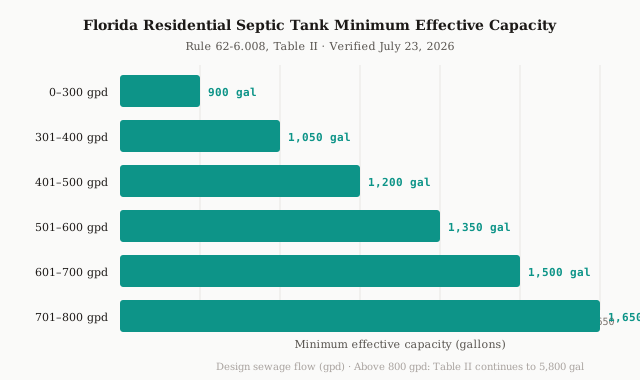
What does the Florida septic tank size chart show by bedroom count?#
Florida Table II requires at least 900 gallons of effective septic-tank capacity for average sewage flows up to 300 gallons per day. That covers the one-, two-, and three-bedroom baseline only while enclosed building area is 2,250 square feet or less; a four-bedroom residence requires 1,050 gallons through 3,300 square feet.
| Bedrooms | Estimated sewage flow | Min. effective tank capacity | Min. residential pump tank capacity |
|---|---|---|---|
| 1 | 100 gpd | 900 gallons | 150 gallons |
| 2 | 200 gpd | 900 gallons | 150 gallons |
| 3 | 300 gpd | 900 gallons | 225 gallons |
| 4 | 400 gpd | 1,050 gallons | 300 gallons |
| 5 | 460 gpd | 1,200 gallons | 375 gallons |
| 6 | 520 gpd | 1,350 gallons | 450 gallons |
| 7 | 580 gpd | 1,350 gallons | 450 gallons |
| 8 | 640 gpd | 1,500 gallons | 525 gallons |
| 9 | 700 gpd | 1,500 gallons | 525 gallons |
| 10 | 760 gpd | 1,650 gallons | 600 gallons |
Source: Florida Administrative Code Rule 62-6.008, Tables I and II. Rule effective July 16, 2013. Crosswalk calculated by Tallahassee Septic Repair Research and verified July 23, 2026. A pump tank is required only where the permitted design calls for one. Primary source: flrules.org/gateway/ruleno.asp?id=62-6.008
This is a baseline, not a bedroom-only rule. The effective-capacity figure can rise when enclosed building area produces the greater estimated sewage flow, and it is distinct from gross tank volume or an informal seller model label.
When does square footage override bedroom count?#
Florida Table I lists bedroom count and enclosed building area as parallel residential flow criteria, and footnote 4 directs the greater estimated flow to control. Building area sets the governing design flow in 45 of the 100 scenarios below; because Table II uses capacity bands, a higher governing flow does not produce a different tank gallon figure in every starred cell.
Cells marked ★ are scenarios in which building area — not bedroom count — sets the governing design flow.
| Bedrooms | ≤750 sq ft | 751–1,200 | 1,201–2,250 | 2,251–3,300 | 3,301–4,050 | 4,051–4,800 | 4,801–5,550 | 5,551–6,300 | 6,301–7,050 | 7,051–7,800 |
|---|---|---|---|---|---|---|---|---|---|---|
| 1 | 900 | 900★ | 900★ | 1,050★ | 1,200★ | 1,350★ | 1,350★ | 1,500★ | 1,500★ | 1,650★ |
| 2 | 900 | 900 | 900★ | 1,050★ | 1,200★ | 1,350★ | 1,350★ | 1,500★ | 1,500★ | 1,650★ |
| 3 | 900 | 900 | 900 | 1,050★ | 1,200★ | 1,350★ | 1,350★ | 1,500★ | 1,500★ | 1,650★ |
| 4 | 1,050 | 1,050 | 1,050 | 1,050 | 1,200★ | 1,350★ | 1,350★ | 1,500★ | 1,500★ | 1,650★ |
| 5 | 1,200 | 1,200 | 1,200 | 1,200 | 1,200 | 1,350★ | 1,350★ | 1,500★ | 1,500★ | 1,650★ |
| 6 | 1,350 | 1,350 | 1,350 | 1,350 | 1,350 | 1,350 | 1,350★ | 1,500★ | 1,500★ | 1,650★ |
| 7 | 1,350 | 1,350 | 1,350 | 1,350 | 1,350 | 1,350 | 1,350 | 1,500★ | 1,500★ | 1,650★ |
| 8 | 1,500 | 1,500 | 1,500 | 1,500 | 1,500 | 1,500 | 1,500 | 1,500 | 1,500★ | 1,650★ |
| 9 | 1,500 | 1,500 | 1,500 | 1,500 | 1,500 | 1,500 | 1,500 | 1,500 | 1,500 | 1,650★ |
| 10 | 1,650 | 1,650 | 1,650 | 1,650 | 1,650 | 1,650 | 1,650 | 1,650 | 1,650 | 1,650 |
Source: Florida Administrative Code Rule 62-6.008, Tables I and II, applying Table I footnote 4. Building area defined in Rule 62-6.002. Matrix calculated by Tallahassee Septic Repair Research and verified July 23, 2026. Every cell is reproducible from the published rule values; the full derivation appears in the methodology section. Primary source: flrules.org/gateway/ruleno.asp?id=62-6.008
The 3,300-to-3,301-square-foot breakpoint
Florida’s bedroom schedule changes in 60-gallon-per-day increments after four bedrooms, while its building-area schedule changes in steps. A four-bedroom residence at 3,300 square feet produces 400 gallons per day by either criterion, mapping to a 1,050-gallon minimum. At 3,301 square feet, the phrase “each additional 750 square feet or fraction thereof” adds a full 60-gallon increment, producing 460 gallons per day and a 1,200-gallon minimum. One square foot across that breakpoint changes the Table II result by 150 gallons.
The same building-area flow step occurs at 750/751, 1,200/1,201, 2,250/2,251, and every 750-square-foot increment above 3,300. Whether a particular step also changes tank capacity depends on the Table II band reached by the new governing flow.
Why a large three-bedroom home changes the answer
Under bedroom count alone, three bedrooms produce 300 gallons per day and a 900-gallon minimum. A three-bedroom residence at 2,600 square feet falls in the 2,251–3,300-square-foot band, which produces 400 gallons per day; footnote 4 carries that larger value forward, and Table II sets a 1,050-gallon minimum. A bedroom-only chart cannot show that result.
What counts as a bedroom, and what counts as building area?#
Both variables are legally defined. Florida uses statutory bedroom criteria and named exclusions rather than a real-estate listing label alone, while the building-area definition excludes several spaces commonly included in broader property square-footage descriptions.
| Criterion | Requirement |
|---|---|
| Floor area (site-built dwelling) | Minimum 70 square feet of conditioned space |
| Floor area (manufactured home) | Built to U.S. Department of Housing and Urban Development standards, minimum 50 square feet of floor area |
| Location | Located along an exterior wall |
| Access and storage | Has a closet and either a door or an entrance where a door could reasonably be installed |
| Egress | Has an emergency means of escape and rescue opening to the outside in accordance with the Florida Building Code |
| Pass-through rule | A room is not a bedroom if it is used to access another room, except a bathroom or closet |
| Named exclusions | Hallway, bathroom, kitchen, living room, family room, dining room, den, breakfast nook, pantry, laundry room, sunroom, recreation room, media/video room, exercise room |
Source: § 381.0065(2)(b), Florida Statutes (2025). Read in full and verified July 23, 2026. Primary source: flsenate.gov/Laws/Statutes/2025/381.0065
Building area, under Rule 62-6.002, is the enclosed habitable area of a dwelling unit, excluding the garage, carport, exterior storage shed, and open or screened patios or decks. It is measured to the outside building dimensions, and enclosed area on every story is added together. A 1,600-square-foot footprint on two enclosed floors therefore produces 3,200 square feet of building area and a 400-gallon-per-day area criterion before comparison with bedroom-based flow.
Note on citation form: published versions of Rule 62-6.002 have assigned different subsection numbers to the Building Area definition. This page cites the defined term by name and uses the current rule record effective July 9, 2025.
How does Florida calculate septic tank size?#
Florida uses a four-step sequence. Bedroom count and enclosed building area each produce an estimated daily sewage flow, the greater flow is carried forward, and that figure is looked up in a separate 16-tier capacity table running from 900 to 5,800 gallons.
- 1Estimated flow from bedroom count. Table I lists 100 gallons per day for one bedroom, 200 for two, 300 for three, and 400 for four. Above four bedrooms, each additional bedroom adds 60 gallons per day.
- 2Estimated flow from building area. Table I lists 750 square feet or less at 100 gallons per day, 751–1,200 at 200, 1,201–2,250 at 300, and 2,251–3,300 at 400. Above 3,300 square feet, each additional 750 square feet or fraction thereof adds 60 gallons per day.
- 3Take the greater flow. Table I footnote 4 governs. Florida does not average the two values and does not automatically default to bedroom count.
- 4Look the governing flow up in Table II.
| Average sewage flow (gpd) | Septic tank min. effective capacity | Residential pump tank min. total capacity | Commercial pump tank min. total capacity |
|---|---|---|---|
| 0–200 | 900 | 150 | 225 |
| 201–300 | 900 | 225 | 375 |
| 301–400 | 1,050 | 300 | 450 |
| 401–500 | 1,200 | 375 | 600 |
| 501–600 | 1,350 | 450 | 600 |
| 601–700 | 1,500 | 525 | 750 |
| 701–800 | 1,650 | 600 | 900 |
| 801–1,000 | 1,900 | 750 | 1,050 |
| 1,001–1,250 | 2,200 | 900 | 1,200 |
| 1,251–1,750 | 2,700 | 1,350 | 1,900 |
| 1,751–2,500 | 3,200 | 1,650 | 2,700 |
| 2,501–3,000 | 3,700 | 1,900 | 3,000 |
| 3,001–3,500 | 4,300 | 2,200 | 3,000 |
| 3,501–4,000 | 4,800 | 2,700 | 3,000 |
| 4,001–4,500 | 5,300 | 2,700 | 3,000 |
| 4,501–5,000 | 5,800 | 3,000 | 3,000 |
All capacities are gallons. Source: Florida Administrative Code Rule 62-6.008, Table II. Transcribed and verified July 23, 2026. Primary source: flrules.org/gateway/ruleno.asp?id=62-6.008
Worked example
A four-bedroom, 3,650-square-foot Florida residence produces 400 gallons per day from bedroom count and 460 gallons per day from building area. Footnote 4 carries 460 forward; Table II places it in the 401–500-gallon-per-day band, producing a 1,200-gallon minimum effective capacity and a 375-gallon residential pump-tank minimum if the permitted design requires a pump tank. A bedroom-only chart would return 1,050 gallons.
How does effective capacity differ from gross tank volume?#
Florida’s Table II values are effective capacity: the liquid volume below the outlet invert. Rule 62-6.013(2)(c) then requires freeboard or airspace equal to at least 15 percent of that effective capacity, so gross internal volume across the liquid and freeboard regions is larger; the approved tank legend itself must state effective capacity.
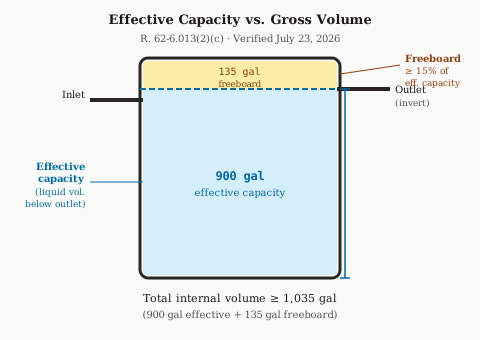
| Required effective capacity | Eff. capacity + 15% freeboard | 1st chamber standalone min. (≥⅔) | 2nd chamber standalone min. (≥⅕) |
|---|---|---|---|
| 900 gallons | 1,035 gallons | 600 gallons | 180 gallons |
| 1,050 gallons | 1,207.5 gallons | 700 gallons | 210 gallons |
| 1,200 gallons | 1,380 gallons | 800 gallons | 240 gallons |
| 1,350 gallons | 1,552.5 gallons | 900 gallons | 270 gallons |
| 1,500 gallons | 1,725 gallons | 1,000 gallons | 300 gallons |
| 1,650 gallons | 1,897.5 gallons | 1,100 gallons | 330 gallons |
The second column is effective capacity × 1.15. Chamber columns are the standalone two-thirds and one-fifth minimums, rounded up. Rule 62-6.013(2)(a) also requires the combined effective capacities of the first and second chambers or tanks to equal or exceed the total required effective capacity. Source: Florida Administrative Code Rule 62-6.013(2)(a) and (2)(c), current version effective June 8, 2026. Calculated and verified July 23, 2026. Primary source: flrules.org/gateway/ruleno.asp?id=62-6.013
Other construction requirements under Florida rules:
- ▸Materials. Tanks must be concrete, fiberglass, or polyethylene. R. 62-6.013(1)(a)
- ▸Liquid depth. Septic-tank compartments must have a liquid depth of at least 40 inches. Depth beyond 84 inches does not count toward effective capacity. R. 62-6.013(2)(b)
- ▸Compartments. Septic and graywater tanks must have multiple compartments, or single-compartment tanks must be placed in series to reach the required effective capacity. R. 62-6.008(2); R. 62-6.013(2)(a)
- ▸Outlet filter. An approved outlet filter is required within or after the last septic tank or compartment before the drainfield; the requirement includes blackwater tanks and excludes graywater, grease-interceptor, and laundry tanks. R. 62-6.008(2)
- ▸Concrete strength. Concrete tanks require a minimum 28-day compressive strength of 4,000 psi. R. 62-6.013(5)(h)
- ▸Access. Each compartment requires a manhole with at least 225 square inches of area; access over the first inlet and last outlet must extend to within 8 inches of finished grade. R. 62-6.013(2)(k)
- ▸Labeling. The DEP approval number and effective capacity in gallons must appear on the inlet-end wall, beginning within 6 inches of the top, in lettering at least 2 inches high. R. 62-6.013(2)(j)
For an existing tank, Rule 62-6.001 provides that tank volume is determined from the tank legend or from internal measurements to the liquid-level line. Entering a septic tank exposes a worker to confined-space hazards, including toxic or oxygen-deficient atmospheres; entry is work for trained and properly equipped professionals. OSHA confined-space standards.
What size drainfield does Florida require?#
Tank capacity is only one part of system sizing. Florida calculates minimum absorption area from design flow and the Table III loading rate for the evaluated USDA soil texture, and the rule applies a 200-gallon-per-day floor to drainfield sizing even when estimated flow is lower.
| USDA soil textural classification | Limitation (percolation rate) | Trench (gal/sq ft/day) | Bed (gal/sq ft/day) |
|---|---|---|---|
| Sand; Coarse Sand not associated with a seasonal water table under 48 inches; Loamy Coarse Sand | Slightly limited (under 2 min/inch) | 0.80 | 0.60 |
| Loamy Sand; Sandy Loam; Coarse Sandy Loam; Fine Sand | Slightly limited (2–4 min/inch) | 0.80 | 0.60 |
| Loam; Fine Sandy Loam; Silt Loam; Very Fine Sand; Very Fine Sandy Loam; Loamy Fine Sand; Loamy Very Fine Sand; Sandy Clay Loam | Moderately limited (5–10 min/inch) | 0.65 | 0.35 |
| Clay Loam; Silty Clay Loam; Sandy Clay; Silty Clay; Silt | Moderately limited (over 15 but not over 30 min/inch) | 0.35 | 0.20 |
| Clay; Organic Soils; Hardpan; Bedrock | Severely limited (over 30 min/inch) | Unsatisfactory for standard subsurface system | Unsatisfactory |
| Coarse Sand with wet-season high water table within 48 inches of the drainfield bottom; Gravel; Fractured Rock; Oolitic Limestone | Severely limited (under 1 min/inch with water table under 4 feet below drainfield) | Unsatisfactory for standard subsurface system | Unsatisfactory |
Source: Florida Administrative Code Rule 62-6.008, Table III. Transcribed and verified July 23, 2026. Primary source: flrules.org/gateway/ruleno.asp?id=62-6.008
| Design flow | Flow used for sizing | 0.80 trench / 0.60 bed | 0.65 trench / 0.35 bed | 0.35 trench / 0.20 bed |
|---|---|---|---|---|
| 100 gpd | 200 | 250 / 334 | 308 / 572 | 572 / 1,000 |
| 200 gpd | 200 | 250 / 334 | 308 / 572 | 572 / 1,000 |
| 300 gpd | 300 | 375 / 500 | 462 / 858 | 858 / 1,500 |
| 400 gpd | 400 | 500 / 667 | 616 / 1,143 | 1,143 / 2,000 |
| 460 gpd | 460 | 575 / 767 | 708 / 1,315 | 1,315 / 2,300 |
| 520 gpd | 520 | 650 / 867 | 800 / 1,486 | 1,486 / 2,600 |
| 580 gpd | 580 | 725 / 967 | 893 / 1,658 | 1,658 / 2,900 |
| 640 gpd | 640 | 800 / 1,067 | 985 / 1,829 | 1,829 / 3,200 |
| 700 gpd | 700 | 875 / 1,167 | 1,077 / 2,000 | 2,000 / 3,500 |
| 760 gpd | 760 | 950 / 1,267 | 1,170 / 2,172 | 2,172 / 3,800 |
Areas are design flow ÷ loading rate, rounded up to the next whole square foot with exact rational arithmetic. The 200-gallon-per-day sizing floor is applied first under Rule 62-6.008(5). Source: Florida Administrative Code Rule 62-6.008(5) and Table III. Calculated and verified July 23, 2026. Primary source: flrules.org/gateway/ruleno.asp?id=62-6.008
Where more than one unreplaced soil texture appears in the relevant profile, the rule bases sizing on the most restrictive texture within 24 inches of the bottom of the absorption surface. Mound systems use separate provisions and are not calculated here. The department may also evaluate percolation results with other site factors, including the performance of systems in the area.
What are the minimum capacities for graywater, laundry, and shared tanks?#
Florida sets separate capacity rules for configurations that are not standard whole-house blackwater systems. One floor remains absolute: a septic tank receiving blackwater may not be reduced below 900 gallons of effective capacity.
| Configuration | Minimum capacity | Rule |
|---|---|---|
| Blackwater septic tank (absolute floor) | 900 gallons effective | R. 62-6.008(3) |
| Multiple dwelling units sharing one tank | Table II capacity plus 75 gallons per dwelling unit | R. 62-6.008(2) |
| Separate graywater tank, flow up to 75 gpd | 250 gallons effective | R. 62-6.008(3) |
| Separate graywater tank, flow over 75 gpd | Average daily flow plus 200 gallons for sludge storage | R. 62-6.008(3) |
| Blackwater reduction where graywater is separated | Reduction capped at 25 percent | R. 62-6.008(3) |
| Separate laundry tank, flow up to 300 gpd | 225 gallons effective, plus 50 gallons per additional 100 gpd | R. 62-6.013(8)(a) |
| Laundry trench drainfield, slightly limited soil, 1–2 bedrooms | 75 square feet, plus 25 per additional bedroom | R. 62-6.008(4)(a) |
| Grease interceptor (not required for residences) | 750 gallons minimum; single chamber capped at 1,250 gallons | R. 62-6.013(7)(d) |
Source: Florida Administrative Code Rules 62-6.008 and 62-6.013, current rule records checked July 23, 2026. Primary sources: R. 62-6.008 · R. 62-6.013
Separating graywater can reduce the blackwater system, but by no more than 25 percent and never below the 900-gallon floor. When an onsite system uses multiple strategies to reduce estimated sewage flow or drainfield size, Rule 62-6.008(1)(b) allows credit for only one reduction method.
Which Florida septic-sizing claims conflict with current sources?#
The statements in the left column either conflict with Rule 62-6.008 or misstate the current program or statutory framework. The right column gives the corresponding Florida rule, statute, or agency result.
| Claim | What the current Florida source provides |
|---|---|
| "Florida requires at least 1,000 gallons for a two-bedroom house." | The minimum effective capacity for average sewage flows up to 300 gpd is 900 gallons. Table II contains no 1,000-gallon tier. |
| "Add 250 gallons for each additional bedroom." | Above four bedrooms, each bedroom adds 60 gallons per day of design flow, not a fixed tank increment. Table II then maps that flow to a capacity tier. |
| "A 1,200-gallon tank is the Florida minimum." | The statewide Table II floor is 900 gallons. The 1,200-gallon tier covers 401–500 gpd — for example, a five-bedroom baseline or any residence whose governing flow is 460 gpd. |
| "Assume two occupants per bedroom at 100 gallons each, so a three-bedroom home generates 600 gpd." | Table I assigns 300 gpd to a three-bedroom residence. Footnote 6 states the occupancy assumption underlying the table; it is not a multiplier to apply again. |
| "The Florida Department of Health sets septic tank sizing standards." | The Onsite Sewage Program transferred to the Florida Department of Environmental Protection effective July 1, 2021, and the rules moved from Chapter 64E-6 to Chapter 62-6. County health departments continue to issue permits in the counties listed by DEP under that route. |
| "Enhanced nutrient-reducing systems must reduce nitrogen by 65 percent before the drainfield." | The statutory definition requires either at least 50 percent total-nitrogen reduction before disposal in the drainfield or at least 65 percent combined reduction from the tank or tanks and drainfield. |
| "Tank size is how much wastewater the tank handles per day." | Design flow is measured in gallons per day; effective tank capacity is measured in stored gallons below the outlet invert. Table II links the measurements but does not make them interchangeable. |
Sources: Florida Administrative Code Rule 62-6.008, Tables I and II and footnote 6; § 381.0065(2)(f), Florida Statutes (2025); Florida DEP Program Transfer. Verified July 23, 2026.
Do these requirements apply to an existing Florida home?#
Not automatically. Florida law contains specific protections for a no-bedroom single-family remodel, permit transfer at sale, disaster reconnection, and rule changes during an already permitted build, while Rule 62-6.001 addresses alterations that increase sewage flow.
| Situation | What the current source provides | Citation |
|---|---|---|
| Remodeling addition, no bedroom added | No existing-system inspection or evaluation and assessment, modification, replacement, or upgrade is required for a single-family remodeling addition or modification if no bedroom is added. The work may not cover the system or encroach on a required setback or unobstructed area. The statute assigns floor-plan and site-plan review within 7 business days. | § 381.0065(4)(bb) |
| Change of use or alteration adding sewage flow | Residential flows are recalculated using new-system criteria for both bedroom count and building area, including the existing structure and proposed addition. | R. 62-6.001(1)(e) |
| Sale of the property | An approved permit transfers with title. A governmental entity may not impose different permit requirements at transfer or mandate an inspection at point of sale, subject to the paragraph's consolidated-government phase-out deferral exception. | § 381.0065(4)(x) |
| Rule change during construction | If a rule changes within 5 years after construction approval but before final approval, the rules in effect at construction approval apply at final approval if fundamental site conditions have not changed. | § 381.0065(4)(aa) |
| Rebuilding after a disaster | A qualifying system is not considered abandoned and may be reconnected to the same type of rebuilt structure with the same number of bedrooms or fewer when square footage is no more than 110 percent of the original and the other statutory conditions are met. | § 381.0065(4)(z) |
| Lots platted before 1972 | Subject to a 50-foot minimum surface-water setback and not subject to lot-size requirements, with projected daily flow capped at 2,500 gallons per acre per day on public water or 1,500 on a water system regulated under § 381.0062. | § 381.0065(4)(i)2. |
| Permit duration | A construction permit is valid 18 months and may be extended once for 90 days. A repair permit is valid 90 days. | § 381.0065(4) |
| Newly adopted onsite rules | Effective July 1, 2026, a newly adopted rule for use and installation of onsite systems does not apply to permit applications submitted within 90 days after the rule's adoption date. | § 381.0065(10) |
Source: § 381.0065, Florida Statutes (2025), as amended by Chapter 2026-62, Laws of Florida; Florida Administrative Code Rule 62-6.001. Read and verified July 23, 2026. Primary sources: § 381.0065, Fla. Stat. · Chapter 2026-62, Laws of Florida
The disaster provision’s 110-percent ceiling is measured against the original structure. Exceeding that figure removes the specific reconnection allowance described in § 381.0065(4)(z), even though other permitting paths may still be available under the governing rules.
Who issues septic permits in Tallahassee and Leon County, and can local rules change the answer?#
Florida DEP has issued onsite sewage permits directly in Leon County since January 2, 2025. The statewide tank-capacity table remains the base sizing rule, while current nutrient-remediation requirements can change the treatment system allowed on a parcel in the Wakulla River and Spring BMAP and Priority Focus Area.
Permitting authority.Leon County was included with 15 other Northwest Florida counties in the first DEP permitting-transition phase on January 2, 2025. Applicants in DEP-permitted counties use Form DEP4015 and the department’s permit and service-request portal, with an application, site plan, building floor plan, and site evaluation; Marion County joined the DEP route on July 1, 2025. DEP states that transition of the remaining 50 counties depends on legislative approval and that local ordinances may exceed state requirements.
Enhanced nutrient reduction.Florida DEP’s February 2026 requirements table places the Wakulla River and Spring BMAP in the category where new-system construction on lots of one acre or less requires ENR, effective July 1, 2023. For an existing system being repaired or modified under a construction permit, any-size lot in the Priority Focus Area requires ENR. DEP-recognized treatment paths include in-ground nitrogen-reducing biofilters, Florida-approved NSF/ANSI 245-certified aerobic treatment units, and Florida-approved nitrogen-reducing performance-based treatment systems.
Scale of the local Priority Focus Areas.Leon County’s Comprehensive Wastewater Treatment Facilities Plan reports 11,917 septic systems across two Priority Focus Areas, with 2,438 — about 20 percent — within Leon County. The report presents potential total-nitrogen reductions across the 11,917 systems from 77,277 pounds per year under an all-upgrade scenario to 112,943 pounds per year under an all-sewer scenario.
Sources: Florida DEP, Onsite Sewage FAQ – Permitting; Florida DEP, February 2026 Enhanced Nutrient-Reducing Requirements for OSTDS; Florida DEP, Permitting of ENR-OSTDS; Leon County Comprehensive Wastewater Treatment Facilities Plan, Task 7 Report. Verified July 23, 2026. Primary sources: Florida DEP Permitting FAQ · DEP February 2026 BMAP table · Leon County Task 7 Report
The official materials reviewed for this release did not identify a separate Leon County bedroom-to-gallon tank-capacity schedule. That statement describes the source review completed July 23, 2026; it does not replace a current parcel-specific permit review.
What changed in Florida septic regulation since 2020?#
Florida DEP estimates that about 2.6 million onsite systems serve roughly 30 percent of the state’s population and represent about 12 percent of U.S. septic systems; groundwater supplies about 90 percent of Florida drinking water. The governing framework has changed since 2020: program administration transferred in 2021, county permitting began shifting in 2025, and Rule 62-6.013 and § 381.0065 were amended in 2026.
The Clean Waterways Act, Senate Bill 712 and Chapter 2020-150, Laws of Florida, transferred the Onsite Sewage Program from the Department of Health to DEP effective July 1, 2021. The rules moved from Chapter 64E-6 to Chapter 62-6. DEP began direct permitting in 16 Northwest Florida counties on January 2, 2025 and in Marion County on July 1, 2025; Rule 62-6.013’s current version became effective June 8, 2026; and Chapter 2026-62 renumbered several § 381.0065 paragraphs and added the new-rule application provision effective July 1, 2026.
Sources: Florida DEP, Onsite Sewage Program; Florida DEP, Program Transfer; Florida DEP, Onsite Sewage FAQ – Permitting; Fla. Admin. Code R. 62-6.013; Chapter 2026-62, Laws of Florida. Verified July 23, 2026. Primary sources: Florida DEP Onsite Sewage Program · Program Transfer page · Clean Waterways Act, Ch. 2020-150
How was this Florida septic sizing dataset built?#
This dataset joins published Florida rule tables; it does not survey installers, price tanks, or model observed household use. Every number is either a primary-source transcription or a disclosed arithmetic result that can be reproduced from the source values.
What we collected, and from where. On July 23, 2026, we read Rule 62-6.008 and its Tables I–III; checked the current official records and adopted text for Rule 62-6.013, whose current version is effective June 8, 2026; read Rules 62-6.001 and 62-6.002; read § 381.0065, Florida Statutes (2025), together with Chapter 2026-62; and checked the cited Florida DEP and Leon County primary materials. No contractor blog, retailer chart, lead-generation article, or secondary legal summary was used as evidence for a published figure.
How the crosswalk was processed. For each of 100 combinations of bedroom count (1–10) and enclosed building-area band (ten bands through 7,800 square feet), we calculated bedroom-based flow, calculated area-based flow independently, selected the greater flow under Table I footnote 4, recorded the governing criterion, and mapped that flow to Table II. The two flows were never averaged, and no commercial rule of thumb replaced a rule value.
Derived values, labeled as derived. Minimum effective capacity plus freeboard is effective capacity × 1.15 under Rule 62-6.013(2)(c). The first- and second-chamber fields are standalone minimums of two-thirds and one-fifth, rounded up; Rule 62-6.013(2)(a) separately requires their combined effective capacity to equal or exceed the total required capacity. Drainfield area is the flow used for sizing ÷ the Table III loading rate, rounded up after applying the 200-gallon-per-day floor.
Quality control. The release is generated with exact integer and rational arithmetic rather than binary floating-point ceilings. Automated assertions verify all 100 tank rows; the 900-gallon three-bedroom result through 2,250 square feet; the 1,050-gallon three-bedroom result beginning at 2,251 square feet; the 45 area-governed design-flow scenarios; the 200-gallon-per-day drainfield floor; every Table II boundary; and the rule that severely limited soil rows do not produce a numeric standard-subsurface area.
What is original here. The rules, statutes, and agency records remain public primary-source material. The 100-scenario joined matrix, governing-criterion field, breakpoint analysis, freeboard and chamber calculations, drainfield-area table, corrected exact-arithmetic outputs, 67-county permitting transcription, versioned CSV and JSON files, and this methodology are original compilation and analysis by Tallahassee Septic Repair Research.
What are the limitations of this dataset?#
This is a planning and reference dataset, not a permit determination, engineering design, approved-product listing, site evaluation, or finding that a parcel can support a particular system. It does not determine setbacks, seasonal high-water-table separation, treatment level, BMAP applicability, repair eligibility, or the final configuration approved by the permitting authority.
- –The matrix covers 1–10 bedrooms and up to 7,800 square feet. Rule 62-6.008 continues beyond that range, and Table II extends to a 5,800-gallon septic-tank tier for 4,501–5,000 gallons per day.
- –Effective capacity is not gross tank volume or an informal model label. The approved legend states effective capacity; freeboard makes the tank's internal volume larger.
- –The chamber columns are not a complete two-chamber allocation. They show standalone minimums. The first and second chambers or tanks together must also equal or exceed total required effective capacity.
- –Local ordinances may be stricter. DEP states that many counties have ordinances exceeding state requirements. This release does not survey all local ordinances.
- –This is residential sizing. Commercial and institutional Table I categories use separate flow values.
- –Mound systems, aerobic treatment units, performance-based systems, and other alternative designs involve provisions not reproduced as sizing tables here.
- –No physical-dimensions dataset is included. Length, width, and height vary by approved manufacturer, material, model, and compartment configuration.
- –The county permitting CSV transcribes DEP's published table. Gilchrist and Lafayette are not listed in either permitting column on the page checked July 23, 2026, so the dataset marks them 'not listed—confirm directly with DEP.'
- –Requirements change. Rule 62-6.002 is effective July 9, 2025, Rule 62-6.013 is effective June 8, 2026, and § 381.0065 was amended in 2026. The visible verification date must be compared with the current source before later reliance.
Figures excluded from this release
These items are outside the verified scope and are not used as current facts anywhere on the page:
- –A statewide or Leon County total beyond the cited FDEP and Priority Focus Area figures.
- –A claim that a named county ordinance raises the 900-gallon state floor.
- –Physical dimensions of approved tank models by capacity.
- –A conclusion about custody of every pre-January 2, 2025 Leon County permit record.
- –The frequently repeated 426-million-gallons-per-day statewide septic-discharge figure. This release does not present it as current because the traced source vintage is not a current measurement.
Where can the Florida septic sizing dataset be downloaded?#
Version 2026.2 publishes four ungated files. No account, email address, or form submission is required. The CSV and JSON files use the same July 23, 2026 verification date and are intended to remain synchronized with the page and change log.
- CSVDownload the Florida septic tank sizing matrix CSV
100 rows covering bedrooms, building-area bands, both flow calculations, governing criterion, tank and pump capacity, freeboard, standalone chamber minimums, the combined-capacity requirement, rule citation, source URL, and verification date.
- CSVDownload the Florida drainfield absorption area CSV
60 rows covering design flow, the 200-gpd floor, soil classifications, trench and bed loading rates, exact rounded-up areas, source URL, and verification date.
- CSVDownload the Florida OSTDS permitting authority by county CSV
67 county rows transcribed from the DEP permitting table, preserving two counties that the source page does not list rather than inferring an authority.
- JSONDownload the complete Florida septic sizing dataset JSON
All three tables, constants, methodology, release notes, and primary-source metadata in a single structured file.
Version 2026.2, published and verified July 23, 2026. No account, email address, or form submission is required.
How should this page and dataset be cited?#
The entries below provide neutral publication metadata for reference managers, footnotes, and data catalogs. They do not alter the underlying Florida agency and statutory sources identified in each table.
Page citation
Tallahassee Septic Repair. “Florida Septic Tank Size Chart by Bedrooms and Square Footage.” TallahasseeSepticRepair.com, https://tallahasseesepticrepair.com/research/florida-septic-tank-size-chart/ Last verified .
Dataset citation
Tallahassee Septic Repair. Florida Residential Septic Tank Sizing Crosswalk, version 2026.2. . CSV and JSON. Available at: https://tallahasseesepticrepair.com/research/florida-septic-tank-size-chart/#download
What are the most frequently asked questions about Florida septic tank sizing?#
These answers restate the chart’s highest-frequency lookups in standalone form. The visible text below matches the FAQPage structured data at the top of the document.
- What size septic tank does a three-bedroom house need in Florida?
- Nine hundred gallons of effective capacity if the home's enclosed building area is 2,250 square feet or less. Between 2,251 and 3,300 square feet the minimum rises to 1,050 gallons, and between 3,301 and 4,050 square feet it rises to 1,200 gallons, because Florida applies whichever of bedroom count or building area produces the greater estimated sewage flow.
- What size septic tank does a four-bedroom house need in Florida?
- One thousand fifty gallons of effective capacity through 3,300 square feet. The minimum is 1,200 gallons at 3,301–4,050 square feet, 1,350 gallons at 4,051–5,550 square feet, 1,500 gallons at 5,551–7,050 square feet, and 1,650 gallons at 7,051–7,800 square feet.
- Is a 1,000-gallon septic tank big enough for a Florida home?
- Florida's residential Table II tiers are 900, 1,050, 1,200, 1,350, 1,500, and 1,650 gallons through the range shown on this page; there is no 1,000-gallon tier. Whether a particular product satisfies a permit requirement depends on its Florida-approved and marked effective capacity, not an informal seller label.
- Does Florida size septic tanks by bedrooms or by square footage?
- Both. Rule 62-6.008, Table I produces an estimated sewage flow from each criterion, and footnote 4 directs that the greater flow applies. In the 100-scenario matrix on this page, building area sets the governing design flow in 45 scenarios, although the Table II tank tier does not change in every one of those 45 cells.
- Does a garage count toward building area in Florida?
- No. Rule 62-6.002 defines building area as the enclosed habitable area of a dwelling unit and excludes the garage, carport, exterior storage shed, and open or screened patios or decks. Enclosed area on every story is added together and measured to the outside building dimensions.
- Does a den, office, or bonus room count as a bedroom?
- Florida applies the statutory bedroom criteria and named exclusions, not a listing label alone. A site-built bedroom must have at least 70 square feet of conditioned space, be along an exterior wall, have a closet and either a door or an entrance where a door could reasonably be installed, and have the required emergency escape opening; the statute expressly excludes dens, media rooms, sunrooms, recreation rooms, and exercise rooms, among other listed spaces.
- If I add a room to my Florida house, do I need a bigger septic tank?
- Section 381.0065(4)(bb), Florida Statutes, protects a single-family remodeling addition from an existing-system inspection, modification, replacement, or upgrade when no bedroom is added, provided the addition does not cover the system or encroach on a required setback or unobstructed area. Rule 62-6.001(1)(e) separately directs residential flow recalculation for alterations that add sewage flow, using both the existing structure and proposed addition.
- Is a septic inspection required when selling a house in Florida?
- A Florida governmental entity may not mandate an onsite-system inspection at the point of sale, and an approved permit transfers with title. Section 381.0065(4)(x) preserves a limited exception for a septic-tank phase-out deferral program implemented by a qualifying consolidated government; private parties may also negotiate an inspection.
- Is septic tank capacity the same as daily wastewater flow?
- No. Design flow is measured in gallons per day and estimates the wastewater load used for system design. Effective capacity is the liquid volume stored below the outlet invert; Table II links the two measurements, but they are not interchangeable.
- Is septic tank size the same as drainfield size?
- No. The drainfield is sized from design flow and the applicable soil loading rate, so identical houses can require different absorption areas. A 300-gallon-per-day residence needs 375 square feet of trench at a 0.80 loading rate and 858 square feet at a 0.35 loading rate.
- What is effective capacity, and why is gross tank volume larger?
- Effective capacity is the liquid volume below the outlet invert, and Florida requires the tank legend to state that approved effective capacity. Rule 62-6.013(2)(c) separately requires freeboard equal to at least 15 percent of effective capacity, so a 900-gallon effective tank needs at least 1,035 gallons of internal volume across the effective-capacity and freeboard regions.
- Who issues septic permits in Tallahassee and Leon County?
- The Florida Department of Environmental Protection has issued onsite sewage construction permits directly in Leon County since January 2, 2025. Leon is one of the 16 Northwest Florida counties in the first permitting-transition phase; Marion County joined the DEP-permitted group on July 1, 2025.
- Can springs-protection rules change what system I'm allowed to install near Tallahassee?
- Yes. Florida DEP's February 2026 table shows that new systems on lots of one acre or less in the Wakulla River and Spring BMAP require enhanced nutrient reduction, and repair or modification permits for existing systems on any-size lot within that Priority Focus Area require ENR. Parcel applicability comes from the current agency map and permit review, not from this statewide sizing matrix.
Which primary sources support this page?#
The source list uses issuing agencies, official rules, statutes, session laws, and the original Leon County report. Each source was checked July 23, 2026 unless a page-specific modification date is stated.
- Fla. Admin. Code R. 62-6.008, System Size Determinations — Tables I, II, and III; greatest-flow footnote; drainfield floor; shared-tank, graywater, laundry, and outlet-filter provisions. Effective July 16, 2013.
- Fla. Admin. Code R. 62-6.013, Construction Materials and Standards for Tanks — Freeboard, chamber requirements, liquid depth, materials, access, labeling, concrete strength, laundry-tank, and grease-interceptor provisions. Current version effective June 8, 2026.
- Fla. Admin. Code R. 62-6.002, Definitions — Current definition of Building Area. Effective July 9, 2025.
- Fla. Admin. Code R. 62-6.001, General — Flow recalculation for alterations and determination of existing tank volume. Effective July 9, 2025.
- § 381.0065, Florida Statutes (2025), Onsite sewage treatment and disposal systems; regulation — Bedroom and ENR definitions, permit durations, and the base statutory text amended in 2026.
- Chapter 2026-62, Laws of Florida — Current paragraph labels for point-of-sale, disaster reconnection, rule changes, and no-bedroom remodeling; new subsection (10). Approved and filed May 6, 2026; subsection (10) effective July 1, 2026.
- Florida DEP, Onsite Sewage Program — Estimated 2.6 million systems, 12 percent of the U.S. total, about 30 percent of Florida's population, and groundwater's share of drinking water.
- Florida DEP, Onsite Sewage FAQ – Permitting — County permitting-authority table, transition timeline, Form DEP4015, portal, application components, and local-ordinance warning. Page last modified January 20, 2026.
- Florida DEP, Program Transfer — July 1, 2021 transfer under the Clean Waterways Act.
- Florida DEP, Permitting of Enhanced Nutrient Reducing OSTDS — Impacted-area framework and Florida-approved treatment categories.
- Florida DEP, February 2026 Enhanced Nutrient-Reducing Requirements for OSTDS — Current new-system and repair/modification categories for the Wakulla River and Spring BMAP and Priority Focus Area.
- Leon County, Comprehensive Wastewater Treatment Facilities Plan, Task 7 Report — 11,917 systems across two Priority Focus Areas, 2,438 in Leon County, and the cited nitrogen-reduction scenarios.
- Florida DEP, Onsite Sewage Data — Florida Water Management Inventory and state fiscal-year OSTDS permit data.
- Clean Waterways Act, Chapter 2020-150, Laws of Florida — Statutory basis for the DOH-to-DEP program transfer.
- U.S. Occupational Safety and Health Administration, Confined Spaces — Confined-space atmospheric and entry hazards.
What changed in this dataset?#
The change log records data, source, and methodology changes rather than cosmetic edits. The visible verification date and structured-data dateModified change only after the cited sources are actually re-checked.
Version 2026.2 —
Completed the current-law audit; updated Rule 62-6.013 to its June 8, 2026 effective version; updated § 381.0065 paragraph labels under Chapter 2026-62; corrected the two-bedroom baseline residential pump-tank figure from 225 to 150 gallons; corrected two exact 700-gpd drainfield calculations from 2,001 to 2,000 square feet; clarified that area governs design flow in 45 scenarios rather than necessarily changing capacity in all 45; renamed the chamber fields as standalone minimums and added the combined-capacity field; replaced the superseded Wakulla May 2024 statement with the February 2026 DEP categories; and synchronized all four downloads and JSON-LD.
Version 2026.1 —
Initial release. Joined Rule 62-6.008 Table I residential flow criteria to Table II capacity tiers across 100 bedroom-by-area scenarios; added the Rule 62-6.013 freeboard and chamber derivation, the Table III drainfield-area table, statutory bedroom and rule building-area definitions, existing-system and point-of-sale provisions, Leon County permitting and Priority Focus Area context, CSV and JSON files, methodology, and limitations.
Tallahassee Septic Repair Research is the independent research and reference section of TallahasseeSepticRepair.com. It publishes dated reference material assembled from public primary sources, with reproducible calculations, source notes, disclosed limitations, versioned files, and documented corrections. This page is not a Florida Department of Environmental Protection publication and carries no agency endorsement. Sizing and treatment determinations for a specific property are made through the applicable permitting process and site evaluation. For further context, see Research & Reference, About, and Editorial & Source Standards. To request septic tank pumping or replacement service in the Tallahassee area, see septic tank pumping.